
until Sunday February 12 2012
Musée de design et d'arts appliqués contemporains
6, place de la Cathédrale
CH - 1005 Lausanne
Switzerland
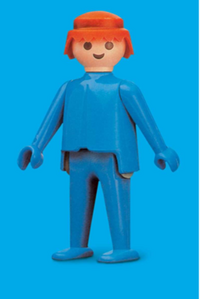
The title of the first exhibition in Switzerland devoted to this famous German line of toys underscores the fabrication aspect that the museum has chosen to highlight in this show.
Transformed into a factory, the mudac galleries reveal how this 3-inch figurine conquered the world, colonizing several generations of children’s rooms. Featuring over 5000 figurines, the show draws a detailed timeline from the initial concept for the toy and its manufacture since its introduction in 1974. In doing so, it showcases the spontaneously submitted children’s drawings received by the firm, as well as the various phases launched by the engineering and design departments, up until the final product’s actual creation and packaging. The presentation underscores the toys’ highly inventive and clever design lines, and the graphic impact of both the object and its wrapping.
A greenhouse lined with myriads of PLAYMOBIL figurines will afford younger visitors a playroom in which to let loose their imagination.
Introduced in 1974, the first PLAYMOBIL figurine revolutionized the toy world. Until then, toy figures — made primarily of lead, paper, painted aluminum and plastic — tended to be frozen into a single stance or motion, their feet molded to the base that kept them upright. Soldiers, cowboys, Native Americans, football and rugby players, or cyclists all embodied a basically warring or sports-dominated world. Children would organize their armies or teams to reenact wars and matches, thus reverting to key moments in history. By inventing a new figurine, Hans Beck was also inventing a new way of playing. The background here is the oil crisis of the time, which forced firms such as the German plastic toy and hobby firm Geobra Brandstätter, for which Hans Beck designed, to come up with smaller-sized and less expensive objects. Beck ‘s unprecedented idea was to bring out a small 3-inch figurine fitting into a child’s hand, with articulated arms and legs and accompanied by sets of accessories. Their face illuminated by a slight smile and a round-eyed gaze, these figurines took off immediately with all children, enabling them for the first time to make up their own role-playing. Indeed, Beck himself explained that the figures were meant to offer an unending range of possibilities, with deliberately neutral facial expressions so that children could choose and make up the various figurines’ character and mood… These come alive in every child’s hand; they can be changed around to their heart’s desire. Thanks to their fantastic power of imagination and the variety of accessories at their disposal, children can thus create an infinite spectrum of situations.
The first play sets made available to the children were divided into three main themes: construction workers, Native Americans and knights. These were colored red, yellow, green, blue or white, and assigned recognizable attributes in the form of caps, ladders, shovels, brooms and rakes for the workers; horses, feather headdress, spears and bracelets for the Native Americans; and swords, capes and crowns for the knights. Over the years, they became equipped with a growing number of further attributes.
Every PLAYMOBIL set receives a great deal of close attention, with much of the research work relying for example on children’s drawings sent in on a daily basis. These provide PLAYMOBIL with a vision of the world through children’s eyes, inspiring numerous new accessories and themes.
To date, 3’200 types of different figures have come into being; their production output comes to over 2.4 billion figures, making PLAYMOBIL one of today’s largest European toy manufacturers.
The exhibition comprises four parts:
• Entitled La vie de tous les jours (EVERYDAY LIFE), the first part uses a toy camping car to showcase the various steps in conceiving and manufacturing a PLAYMOBIL object. It features former models of the car, the ideas and drawings submitted by children, the sketches proposed by the R & D Department, construction drawings, certain foam pre-models, steel molds for various camping car parts and examples of the Polystyrene grains that represent the basic PLAYMOBIL construction material. A second showcase follows the evolution of construction
and police play sets from the 1970s until present times; it is brought alive thanks to a miniature freight train that runs through it non-stop.
• Voyage dans l’histoire [JOURNEY THROUGH HISTORY] invites viewers to follow the figurines from the first three models (Native Americans, construction workers and knights) dating back to 1974 until the most recent figures of the toy line: a family in bathing suits. The second
showcase traces the chronology of human civilization through sets of persons and architectural models, from pre-history to our possible presence a new planet. Illustrating this section is a series of preliminary sketches and split open figurines.
• Nos amies les bêtes [OUR ANIMAL FRIENDS] divides all the species of animals manufactured by the toy company into five themes: wild, domestic, exotic, aquatic and aerial. A second showcase elaborates on the horse world, displaying all the PLAYMOBIL figures that fall under
that heading. By presenting the architectural models accompanying its animal figures, such as modern farms, various types of zoos and veterinarian clinics, PLAYMOBIL Fab underscores all the precision and loyalty to realism that are the mainstays of the brand’s success story.
• L’amour du détail [LOVE OF DETAIL] gives visitors an overview of many of the accessories linked to the figurines. The exhibition’s innovative showcasing does full justice to the tiny objects, displaying them in exact replicas of our surroundings. We are invited to stroll along a shop-lined street whose store windows are overflowing with miniature toy elements.
Separate exhibition sectors cover this German toy line’s trademark graphic design and packaging .
Last but not least, on view at the mudac is a plastic injection machine from the Dietenhofen production site: visitors are welcome to take home with them one of the mice it spews forth non-stop. A screening of newsreels and commercials from 1976 until the present time puts a final touch to the exhibition.