
until Sunday May 13 2012
Museum Boijmans Van Beuningen
Museumpark 18-20
3015 CX Rotterdam
The Netherlands
T : +31 (0)10 44 19 400
F : +31 (0)10 43 60 500
info@boijmans.nl
www.boijmans.nl
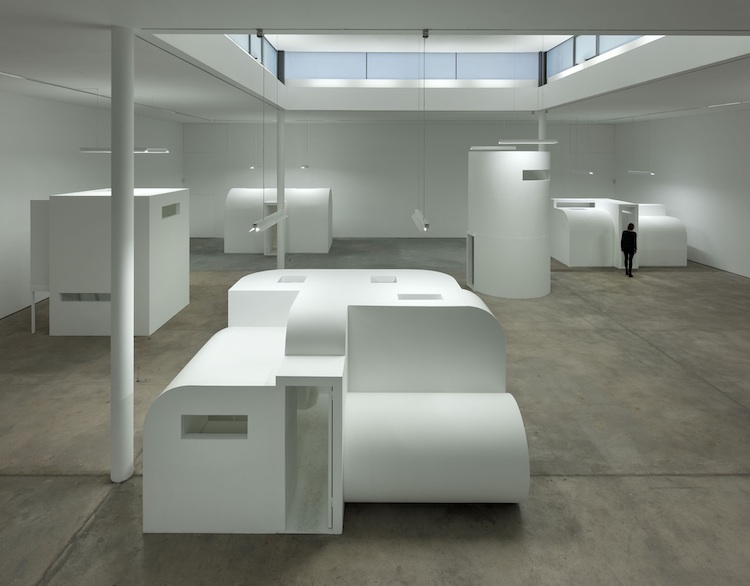
During the busy annual ‘Rotterdam Art Weekend’, which includes the ‘Art Rotterdam’ and ‘Object Rotterdam’ fairs, Museum Boijmans Van Beuningen will open its major spring exhibition of Absalon. A collection of mainly large, white objects, models and films made by an artist who created a great impression before he died at a young age in 1993.
Absalon (1964-1993) is known for the living cells constructed entirely from wood and painted in neutral white which he made for six world cities: Tokyo, New York, Tel Aviv, Paris, Zurich and Frankfurt. He called them "Cellules". Museum Boijmans Van Beuningen is exhibiting a selection of these living cells together with furniture, drawings, photos, films and test constructions that preceded them.
The form of Absalon’s Cellules is reminiscent of the modernist architectural styles of Le Corbusier, Bauhaus, De Stijl and the Russian constructivism. They are, however, stripped of their Utopian ideals. {The living cells are based on the dimensions of Absalon’s own body and are, as it were, air-raid shelters for just a single person. Each Cellule contains everything needed for daily ritual actions down to the last detail, including slit windows to keep an eye on unwanted guests. The spaces suggest a need for protection and shielding from the chaotic daily life. Absalon described his Cellules as “a bastion of resistance against a society that prevents me from becoming what I must become.”
During the development of the Cellules, Absalon also started working with film. His videos give his oeuvre a new frame of reference. His work refers not only to the constructivism and architecture based on geometric principles, but also to the body and performance art of the sixties and seventies.
Curated by Susanne Pfeffer, the exhibition was previously compiled by KW Institute for Contemporary Art in Berlin. A huge part is now being exhibited in Rotterdam.