|
MODEM Dialogues
in conversation with Yaku Stapleton
|
|
|
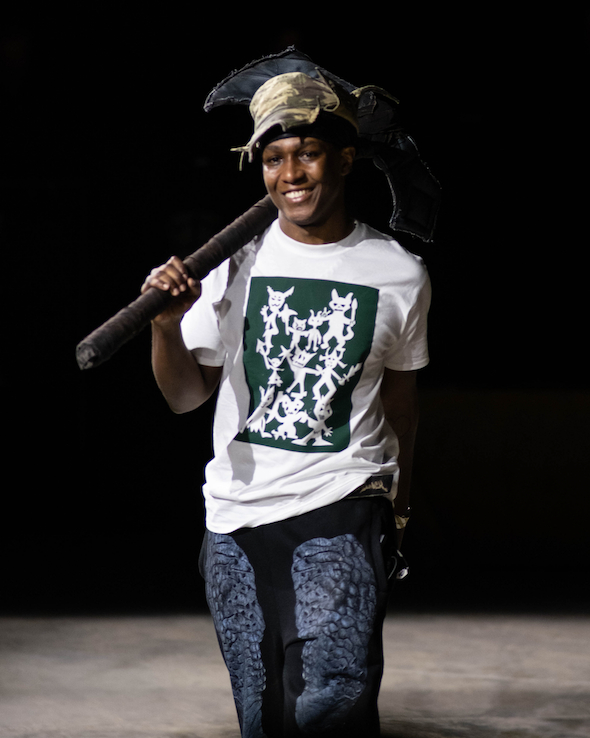
Yaku Stapleton. Founder of YAKU
Portrait Yaku Stapleton ® Agathe Moubembe
Questions conceived and hosted by Florian Müller
Modem: Storytelling in your practice carries traces of memory and continuity. When does narrative shift from recalling the past to actively shaping the present?
Yaku Stapleton: I find myself going back and forth between the two constantly, but I can only really focus on one at a time and let my subconscious handle the mix-and-match part. I usually look to the past to find answers or direction for the present, but once those answers evolve or reach a kind of checkpoint, I circle back to the past again. What I find fascinating is how, as I grow, returning to the same topics a second or third time feels completely different. The impact those events or references have on me shifts in profound ways - sometimes for the better, and sometimes for worse.
Modem: Elements of identity and heritage appear in your work. Which moments allow a personal story to resonate universally ?
Yaku Stapleton: That comes from trusting that our experiences as people - although really different depending on place, time, how you look, and who raises you - still share a lot of similarities across the world. Trusting in those similarities gives us confidence to lean more into our personal stories, with the hope and trust that through those shared parts of human existence, they’ll resonate with others. I’ll admit, sometimes it feels like the range of experiences and nuances in my life are unique to me. But every time I share something or speak to someone about what we create, I’m reminded that we’re all a lot more similar than we think.
Modem: Collaboration has become a common term within cultural production. Who sets the conditions for genuine co-creation to emerge?
Yaku Stapleton: From my experience, these conditions have to come from every person involved in the project or collaboration - for genuine co-creation to happen, everyone taking part needs to be honest and open about what they’re thinking and what they want from it. Time is also a major condition, and it’s something often none of us can control. You can’t predict when something great will come from a genuine connection, and trying to rush that spark never works. And even when it does happen, taking the time to nurture it and let the idea breathe is always needed.
Modem: Collective work relies on a rhythm of trust that can easily fracture under strain. How is connection restored once it falters?
Yaku Stapleton: Having a solid plan for how we want to approach things across the whole project is key for when things get tricky. People often fall back on their defaults when they’re stressed or when something goes wrong, so having a clear plan and rhythm in place gives everyone something steady to lean on when things get tense. If that doesn’t work (which is entirely possible), then it’s good for everyone involved to take a step back and remember that the primary goal is always to improve themselves and push the work. Keeping that in mind makes it easier to appreciate the passion of someone you might not fully agree with. Everyone’s just trying to get better every day, and we must remember that.
Modem: Interdisciplinary collaborations bridge art, design, and community. Whose project has left the most lasting impression on your approach?
Yaku Stapleton: I always find it hard to scan the internal hard drive of my brain and pinpoint the exact external influences that have shaped me, but the first thing that comes to mind in this context is Isamu Noguchi’s work. He explored parks and playgrounds, shifting beautifully from miniature to full-scale, from sculpture to function - which I found fascinating to discover. I came across it at a time when I was just realising that creativity was something possible for me, so it’s really stayed with me since. It’s a project that sits somewhere between sculpture, model-making, human geography, spatial design, function, and emotion - and all of these layers come together so seamlessly. Even though it’s a well-known example, it really does embody everything I value about interdisciplinary collaboration.
Modem: Crossing cultural and creative boundaries reshapes perspective. Why do these encounters reveal new roles for designers today?
Yaku Stapleton: People’s needs are always changing, and with that, the ways we respond creatively must also evolve. When creativity is used to solve problems and create space for new possibilities, it naturally pushes design forward. These encounters challenge us to listen carefully, and to design adapted to a constantly evolving world. As a designer who’s still early in my journey, it’s tricky to feel the role we serve is truly defined. Time will tell. In the meantime, it feels important to acknowledge that the responses and ideas we have for the moment we’re in now are important, and can still be helpful, even if the space for them isn’t clear yet. In fact, especially if it isn’t.
Modem: Paths outside traditional fashion structures follow their own rhythm. In what way do you sustain direction and clarity within that freedom?
Yaku Stapleton: If I had to put it in one word, I’d say difficulty. But I think sustaining direction and clarity within that freedom comes from understanding tradition and the existing frameworks first. They form the foundation we’re building upon, helping us see where we want to go and how we want to differ from what’s come before. The clarity comes from knowing that history - understanding where things have been gives us a sense of purpose in where we’re going. And sustaining direction, I think, is about constantly questioning our decisions, critiquing ourselves, and finding better ways to communicate how much we care about what we’re doing.
Modem: Intense creative pressure tests focus and balance. Can strategies help you remain grounded during consuming phases?
Yaku Stapleton: My main aim during these phases is to stay healthy - that’s the foundation that allows me to make decisions when things get overwhelming. This starts with routine and simple discipline - getting enough sleep, eating well, cycling to and from work. These things make a huge difference in keeping my thoughts positive and forward-focused when times are intense. As a team, our daily stand-up is a grounding practice - starting every morning by sharing one good and one difficult thing from the previous day, and anything we might need help with. It’s a small ritual that reminds us that no matter how intense things get, each day is its own.
Modem: Conversations around mental health in creative work have multiplied, yet deep change remains rare. Where do obstacles still prevent transformation?
Yaku Stapleton: We’re in a time where we can constantly see the incredible things everyone else is doing online without necessarily knowing how they got there. That can easily feed the pressure to keep producing, improving, or slipping into comparison. It doesn’t help that creative work is largely solitary. That feeling of being on your own, rather than “in it together,” can make things really tricky. And even though isolation contributes massively to mental health struggles in this industry, there’s still a tendency to glorify the lone artistic journey. Most people probably just really need someone to talk to.
Modem: The future of fashion raises questions about persistence and change. Should certain elements remain, and what structures require rethinking to keep the field reflective rather than purely productive?
Yaku Stapleton: I often question the current Fashion Week schedule, as even one show a year can be a huge undertaking, but in my experience it’s often enough for real reflection and expression. They also don’t need to be these giant, extravagant events that cost thousands. Creatively, I always look up to Ellen Poppy Hill’s shows - limited budgets, but so much passion and emotion. Her last show was one of the best I’ve ever seen. The field will grow if it sustains these honest, raw expressions instead of prioritising productivity, exposure, and profit. Supporting a wider range of people, backgrounds, and stories at their own pace is key - that’s how you create a more reflective space.
Interview by Florian Müller for MODEM
Portrait Yaku Stapleton ® Agathe Moubembe
MODEM Dialogues.
23.06.2025 with Serge Carreira
07.07.2025 with Simon Whitehouse
21.07.2025 with Orsola de Castro
04.08.2025 with Bandana Tewari
18.08.2025 with Scott Lipinski
01.09.2025 with Sophia Chong
15.09.2025 with Sara Sozzani Maino
29.09.2025 with Tasha Liu
13.10.2025 with Madame Lv
27.10.2025 with Sakina M'sa
10.11.2025 with Eduarda Abbondanza
|
|
|
