



Article by Florian Müller.
Writing a press trip without prejudice is difficult when the taste of excellent food has barely faded and the rituals of hospitality are playing out somewhere in the background. What matters actually is what endures once a certain distance begins to form.
It appears nearly impossible to arrive in Trieste without first being warned about the Bora. The wind that moves through the city with such force that it can throw people off balance. Stories circulate of stones carried in pockets, of ropes fixed along streets so pedestrians can keep moving forward. The Bora never arrived during those days. And yet it stayed perpetually present as an image. Because that particular vibe of resisting immediate displacement, of holding one’s position despite pressure, surfaced across the city.
Trieste is often described as the least Italian place in Italy, shaped by overlapping histories and cultural intersections that still reveal themselves. Much here functions discreetly, more cautiously, less polished than in the major fashion capitals further west or north. For that very reason, it initially seems surprisingly unexpected that International Talent Support, one of the most influential platforms for emerging fashion talent, should have developed here of all places. Nonetheless it makes complete sense. ITS has never operated like a conventional competition. It resembles something slower and complex: a framework built over decades through encounters, steadfastness, preservation, trust, and an unusual degree of attentiveness.
Barbara Franchin, founder of ITS and the driving force behind ITS Arcademy, did not simply establish an initiative in Trieste. Over twenty-four years, she constructed an entire ecosystem. Young creatives working in fashion, textiles, jewellery, accessories, image-making, material experimentation, and object design apply from around the world. From these submissions, a small number of finalists are invited to Trieste for an intensive residency-style programme involving workshops, presentations, conversations, mentorship, and collective exchange. That is where ITS fundamentally separates itself from many other industry formats. The emphasis lies less on rapid selection than on creating environments under which unfamiliar practices can continue developing before being flattened by commercial expectation.
Even the arrival seemed to establish a particular energy. People applauded when the plane landed. And again, when it departed days later. Such gestures may look incidental, but they often reveal deeper truths about a place than official speeches ever could. The same absence of affectation extended throughout the entire experience. In a field where many events slowly dissolve into exercises of mutual self-stylisation, the attention here stayed unusually centred on the work itself and on the people actively in the fragile process of shaping it.
It was notable how often one met individuals who had not previously known ITS and had nevertheless already entered its orbit. A chauffeur who had returned to Trieste after years away admitted he had never heard of the platform before transporting guests during the event. Interactions like that made visible how gradually the project has inscribed itself into the city rather than existing separately from it.
That said, Trieste is far from merely functioning as scenery. It would be misleading to suggest that the city only acquired cultural relevance through the existence of ITS. Quite the opposite. The project encountered a place already marked by artistic and intellectual traditions. References surfaced repeatedly to Anita Pittoni, whose work connected craftsmanship, literature, publishing, and visual culture, or to Ottavio Missoni, who drew lasting inspiration from the surrounding landscape. In that respect, ITS does not feel imported into Trieste. It feels just like a contemporary continuation of an older local stubbornness already embedded there.
Alda Balestra von Stauffenberg belongs in that same constellation. Born in Trieste, she became Miss Italia in the early 1970s before beginning an international modelling career. In 2023, for the opening of ITS Arcademy, she placed her Valentino wedding dress there on long-term loan. This is not only a place from which trajectories begin, but also one to which people return.
That same mixture of rootedness and openness shaped many of the conversations with finalists. Tidjane Tall spoke about proposing a different perspective on elegance, especially in relation to the Black body, not through spectacle but through subtle displacement of perception. Wenji Wu initially described the experience virtually as an interruption from everyday work, before later comparing it to a spring camp in which movement, exchange, and learning unfolded simultaneously. What mattered to him extended outside fashion itself toward sustainability, business structures, and the long-term foundations necessary for creative survival. That broader perspective often is missing in comparable industry settings.
Officially, invited guests were on site primarily for two central days, while the finalists had by then spent considerable time together beforehand in workshops, discussions, and presentations. The atmosphere felt less confrontational than cumulative, less like a contest than a gradual process of building something collectively.

- Group photo: Photography by Giuliano Koren
This year’s theme was Rise and Shine. In other contexts, such phrasing might easily have collapsed into a slick slogan of encouragement. In Trieste, however, it acquired a subtler meaning. Not self-exaltation, not dazzling visibility, but rather a careful coming into view. Barbara Franchin repeatedly returned to the importance of approaching young creatives with openness and generosity instead of unnecessary severity. When she began addressing the audience after one exhibition tour, her voice was initially so quiet that parts of the room were slightly settling themselves before realising she had at that point started. Seconds later, attention had entirely shifted toward her. Not because she imposed herself, but because she spoke with a kind of calm precision that reshaped the entire dynamic around her. Later came the sentence: “I think you know that we are doing something together.” It did not interrupt the tension so much as quietly articulate something that had previously been there from the start.
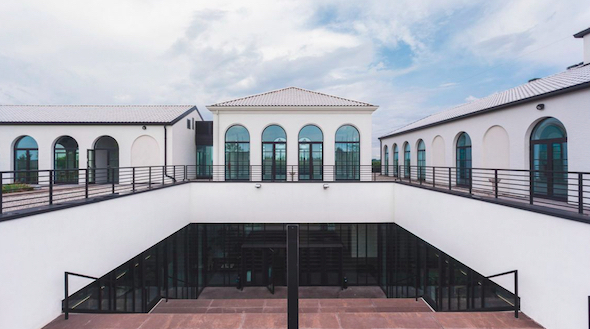
A first walk through ITS Arcademy reveals the scale of what has developed here. The institution functions simultaneously as archive, museum, exhibition space, and research centre. Noteworthy is the Wunderkammer, where roughly 15,000 portfolios are preserved. Their sheer physical scale makes immediately clear that what is archived here are not merely successful careers, but attempts, processes, unfinished directions, stages before recognition fully arrives.
The archive never reads static. A large projection book allows portfolios to reappear in motion rather than sitting frozen behind glass. Pages look close to turning on their own. For brief moments, one slips into something akin to dreaming, as though these works were still continuing to unfold somewhere beyond the archive itself. The past is not exclusively stored there. It keeps re-entering current experience.
- Library: Photography by Massimo Gardone
That enduring thread becomes particularly evident in light of Costume Art at the Metropolitan Museum of Art in New York. Several designers connected to ITS Arcademy are currently included in the exhibition, including Demna, Matthieu Blazy, Richard Quinn, Yuima Nakazato, Clémentine Baldo, and Seiran Tsuno. The latter, finalist of ITS 2018, first presented a project shaped by her experience as a psychiatric nurse. Wandering Spirits explored unstable boundaries between bodily perception, psychological projection, fragility, and material presence through delicate structures produced using fused filaments applied with a 3D pen. The resulting forms appeared suspended somewhere between garment and apparition. For Costume Art, the curator Andrew Bolton invited Tsuno to reinterpret one of these works specifically for the exhibition, where it now enters into dialogue with the museum’s wider reflection on the body, representation, and fashion as cultural practice. What shows up today at the MET as institutional recognition often existed earlier in Trieste in a far profoundly vulnerable state: as experiment, proposition, or unresolved question. The archive at ITS therefore does not solely preserve outcomes. It safeguards instances before certainty fully settles around them.
Back in Italy, that same perspective shapes the exhibitions themselves. Exposure – The Power of Being Seen, curated by Tom Eerebout, explored the relationship between garment and body through corsetry, shaping, armour-like structures, and physical transformation. Fashion counted there not as decorative surface, but as something capable of altering bodily experience and perception itself.
Everywhere in the building, the word “Create” recurs repeatedly, sometimes directly, sometimes indirectly. Not as branding, but as an underlying condition of the place. It gradually becomes clear that creation here does not simply mean producing objects. It means constructing contexts, materialising thought, sustaining dialogue, and allowing relationships to develop over time.
This was chiefly pronounced during the finalists’ presentations. Chloë Reners explored distortion, body perception, and inherited imagery through 3D printing and research into family archives. Darius Betschart merged medieval references with denim, technical fabrics, and contemporary subcultural language. Anna Maria Vescovi drew from research conducted within the archives of the Paris Opéra Garnier. Steven Chevallier intertwined queer histories, exclusion, illness, colour, and knitwear into a practice shaped by social memory and resistance rather than purely aesthetic gesture.
Barbara Franchin noted that an unusually large number of submissions this year engaged directly with social tensions, identity, history, and structures of power. The projects rarely functioned as simple styling exercises. Most turned instead as responses to contemporary conditions.
Stan Peeters approached fashion through architecture, furniture, and spatial thinking, developing parts of the work alongside members of his family. William Palmer introduced absurdity and humour into his reflections on dominance and capitalism without allowing the work to collapse into irony. Wenji Wu connected protective figures, dream imagery, and psychological balance into textile worlds resembling materialised inner states. Yi Ding translated childhood memories, matriarchal histories, and familial narratives into dense textile constructions. Jamie O’Grady, the only footwear designer of all the finalists, focused less on self-expression than on systems, modularity, sustainability, and meaningful construction.

- Looks of 10 finalists: Photography by Massimo Gardone
What connected these otherwise highly distinct positions was less a shared aesthetic language than a shared emotional sensibility.
The composition of the jury reflected that same breadth, spanning design, theory, journalism, sustainability, curation, and cultural criticism. On the list were Carlo Capasa, Sara Sozzani Maino, Takeharu Hirakawa, Karen Binns, Orsola de Castro and Odunayo Ojo.
The press conference likewise made visible how strongly ITS is built around ideas of persistence and collective investment. It was described as bringing something contemporary into a city largely shaped in many ways by older structures and rhythms. Renzo Rosso, speaking as a long-term supporter, remarked with a mixture of admiration and amusement that Barbara Franchin was clearly not an ordinary person, but someone whose tenacity and singular vision had slowly built an entire reality around herself. What became perceptible throughout those days was how many dimensions continuously intersected there at once: archive, city, institution, mentorship, industry, friendship, experimentation, memory.
Barbara later mentioned continuing to plant “seeds.” The image extended naturally into the award ceremony itself. ITS no longer follows the habitual logic of a single triumphant winner. All ten finalists received the I:C 10x10x10 Award, tied to financial support, residency opportunities, and inclusion in the exhibition, while Chloë Reners additionally received the Jury Special Mention. Further partner awards were distributed among the cohort, reinforcing the collaborative rather than competitive structure of the platform.
During the ceremony, enlarged projections of the finalists and their work moved along an oversized screen while Barbara stood almost unnoticeably at its outer edge, partially absorbed by the darkness beside the projection.

- Stage: Photography by Florian Müller
The image carried something unexpectedly tender. Not the gesture of dramatic withdrawal, but of someone allowing attention to settle fully on a different point of focus. At the same time, it had already become physically palpable that these ten individuals no longer constituted a temporary group assembled around a distinction. A different kind of closeness had emerged between them during those days. One sensed it in interrupted voices, in tears, in gestures of affection, but also in quieter gestures that passed barely unnoticed. The atmosphere carried less the impression of completion than of departure accompanied by the certainty that something would continue beyond the visible event itself.
Perhaps it was precisely this absence of pretension that made the experience resonate so strongly afterwards. Even during dinners, the emphasis lay on exchange over presentation. Seating arrangements continually shifted, not to reinforce hierarchy but to open different conversations. Barbara moved gently between tables, ensuring people were noticed without theatricality. One restaurant owner carefully introduced the various cuts of meat before the meal arrived. Later, on the way toward a smaller afterparty, a local proprietor, visibly delighted by the warmth surrounding the group, spontaneously began adding free beer and pizza to already ordered drinks. The gesture itself was simple. What remained was the kindness behind it.
In general, there was constant laughter, embracing, lingering conversations, occasional tears. In another context, such phases might disappear immediately. Here they accumulated into something strangely durable.
One comparison surfaced repeatedly during conversations in Trieste: the Barcolana sailing regatta, once relatively local and now the largest event of its kind worldwide. Someone remarked that ITS might develop similarly. Perhaps the city itself does not yet fully grasp what has steadily taken shape there over the past decades. But one could already perceive an understated form of civic attachment beginning to emerge. Not the loud claiming of prestige common within larger cultural capitals, but something slower, more reserved, perhaps more Triestine in character.
And that is why the image of the Bora felt fitting in the end. Not because the wind ever arrived during those days. But because one repeatedly had the feeling that something was being practised there that is increasingly rare elsewhere: not to be swept away immediately. But to resist instant erasure. To hold one’s ground. And from that position to build something capable of creating not only landmarks, but futures.
> About Florian Müller,
> Fondazione ITS

© Modem